
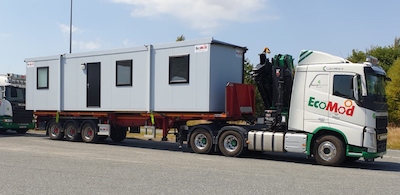
Words like prefabricated, modular, portable and temporary are often used to mean the same thing, which makes it hard to know what you actually need. This guide explains what each one means, the main types you can get in Ireland, where they’re used, and how fast one can arrive.
What Is a Prefabricated Building?
A prefabricated building is any structure manufactured off-site, in a factory or purpose-built facility, before being transported and assembled on location. This approach reduces weather-related delays, improves consistency, and allows site preparation to happen at the same time as manufacturing.
These terms often get mixed up, so here’s what each one really means:
- Prefabricated: a general term for any building, or building component, made off-site rather than constructed entirely on location.
- Modular: built from repeatable modules or units, which can be used alone or combined to form larger buildings.
- Portable: designed to be relocated, rather than fixed permanently in place.
- Temporary: intended for short-term or interim use, and typically removed once that need ends.
Types of Prefabricated Buildings in Ireland
Prefabricated buildings in Ireland cover a wide range of uses, sizes and specifications. The main categories are:
- Portable cabins and site offices: single-unit buildings used for site management, storage or short-term office space, quick to deliver and install
- Welfare units: combined canteen, toilet and drying facilities for construction crews, often hired for the length of a contract
- Modular classrooms: used by schools and colleges to add capacity quickly during renovation, expansion or rising pupil numbers
- Modular healthcare buildings: used for clinics, wards and testing units, particularly during hospital refurbishment or expansion
- Modular office space: flexible, scalable workspace that can expand or contract as a business grows or changes
- Prefab homes and garden rooms: residential units ranging from small garden offices and granny flats to full-sized houses
- Prefab steel and industrial buildings: used for agricultural storage, workshops and light industrial space where strength and durability matter most
- Multi-storey modular buildings: larger complexes built from multiple linked modules, used for hotels, apartments and hospital extensions, with stacked units increasing the number of cabins available where site space is restricted
How different industries use prefabricated buildings in Ireland
Different sectors tend to gravitate towards different building types, largely because of how quickly space is needed and how long it needs to last. The table below summarises how different sectors in Ireland typically use prefabricated buildings.
- Construction: site offices, welfare facilities and storage, typically using portable cabins or welfare units
- Education: extra classrooms during expansion or renovation, typically using modular classrooms
- Healthcare: interim clinical space and testing units, typically using modular healthcare buildings
- Retail and events: pop-up shops, ticket offices and registration points, typically using portable cabins
- Residential: granny flats, garden offices and full homes, typically using prefab homes
- Agriculture and industry: storage, workshops and light industrial space, typically using prefab steel buildings
Prefabricated vs traditional construction
Prefabricated and traditional construction both produce finished buildings, but the process, and the trade-offs, differ considerably.
| Factor | Prefabricated | Traditional |
| Build time | Manufactured off-site while groundworks proceed in parallel | Sequential, built entirely on site |
| Weather disruption | Minimal, factory-controlled conditions | Higher, can delay on-site work |
| Quality control | Consistent, produced in controlled conditions | Variable, dependent on site conditions |
| Waste | Lower, materials precision-cut off-site | Higher, more waste generated on site |
| Site disruption | Reduced, shorter on-site works | Extended, ongoing site activity |
| Customisation | Good, though some standardisation applies | Full customisation possible |
Choosing the Right Type for Your Project
With so many options available, a few questions help narrow down the right fit:
- Purpose: is the building for construction support, education, healthcare, retail, residential or industrial use?
- Duration: do you need it temporarily, for a fixed project, or permanently?
- Budget: does a standard specification meet your needs, or is a bespoke build justified?
- Site conditions: what access, groundworks and utility connections are available?
Answering these questions early makes it far easier to choose the right building type and set a realistic timeline from the outset. It is generally far cheaper to clarify these details before ordering than to change specification once manufacturing has already started.
Not sure which type of prefabricated building suits your project? Our team will guide you through every step of the process, from start to finish.
Frequently Asked Questions
What is the difference between a prefabricated, modular and portable building?
Prefabricated is a general term for anything built off-site. Modular refers specifically to buildings made from repeatable units or modules. Portable describes buildings designed to be relocated.
How fast can you get a prefabricated building in Ireland?
This depends on stock availability and manufacturing schedule rather than a fixed timeline, so it varies by provider. As a general guide, a standard portable cabin already in stock is the quickest option, modular classrooms and offices take longer since more fit-out is usually involved, and bespoke homes or larger multi-module buildings take the longest, since they are built fully to order. Always confirm an exact timeline with your provider.
Can a prefabricated building be used as a permanent structure?
Yes. Many prefabricated and modular buildings are designed for long-term or permanent use and are built to the same regulatory standards as traditional construction, including offices, schools and residential developments.
Can a prefabricated building be used as a permanent structure?
Yes. Many prefabricated and modular buildings are designed for long-term or permanent use and are built to the same regulatory standards as traditional construction, including offices, schools and residential developments.
Are prefabricated buildings suitable for the Irish climate?
Yes, as long as they’re built to a proper standard. Modern prefab buildings use insulated walls and roofs that keep out draughts and damp, which suits Ireland’s wet, changeable weather far better than the old-style prefabs did.