
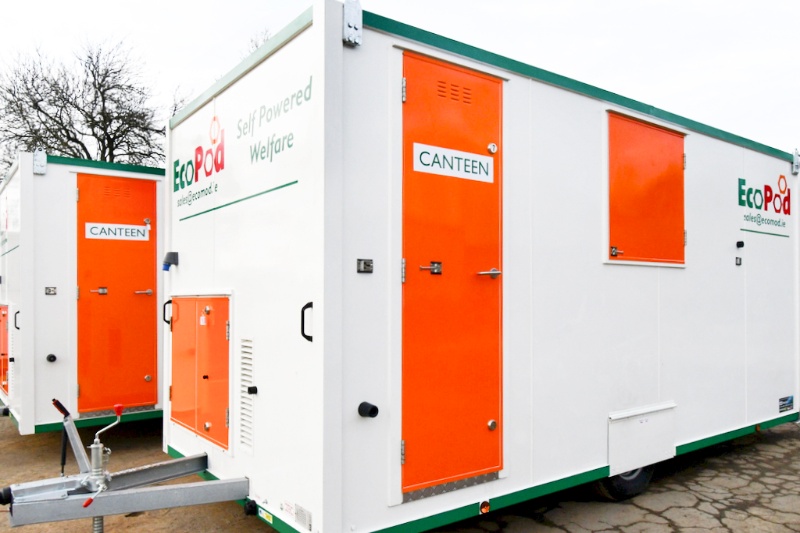
Welfare facilities are easy to forget when planning a site, until workers turn up with nowhere to eat, wash, or dry off. A mobile welfare unit fixes this in one delivery.
Workers who have a warm, dry place to eat and clean facilities to use tend to be happier and get more done. A well-run setup also looks good for the whole project.
The term “welfare unit” covers a lot of products. These range from small towable units for a few workers, to larger static cabins for long-term sites with dozens of staff. Picking the wrong type or size is a common mistake, and it’s easy to avoid. The trouble is, it often only shows once the site is already up and running.
This guide explains what a mobile welfare unit is, what the law requires in Ireland, what you’ll find inside one, and how to choose the right size and type for your site.
What is a mobile welfare unit?
A welfare unit is a portable facility that provides workers with essential amenities, typically a toilet, washing facilities, a rest and eating area, and somewhere to dry wet clothing and PPE.
You can move it between sites easily with a normal pickup or light truck, and you don’t need a crane to deliver it.
This makes mobile units a good fit for smaller sites, short jobs, and work that moves around, like utility or road maintenance.
Why welfare units are a legal requirement in Ireland
On a construction site, welfare facilities are not optional. The Safety, Health and Welfare at Work (Construction) Regulations 2013 spell out what you must provide, and the Health and Safety Authority checks that the rules are followed. Contractors have a legal duty to provide welfare facilities, and clients must make sure this actually happens.
At the very least, welfare facilities should include:
- Sanitary and washing facilities, including a toilet and a wash basin with hot and cold running water.
- A supply of drinking water.
- An adequate rest area, protected from the weather, with somewhere to sit.
- Somewhere suitable to eat, away from areas where dust or hazardous substances are present.
- Drying facilities for wet clothing and personal protective equipment.
What’s inside a mobile welfare unit?
Our mobile welfare units come with the following:
- Canteen and rest area: seating and table space for workers to eat and take breaks out of the weather.
- Flushing toilet and wash basin: with hot and cold running water, soap and towels.
- Drying or changing room: for wet clothing, boots and PPE.
- Self-contained power and water: an onboard generator, lighting, and water and effluent tanks, so many units can be used without a mains connection.
- Towable chassis: light enough to be towed on site by a standard pickup or light truck, with no crane required.
- Retractable jacklegs: for quick, level setup on most solid surfaces.
- Anti-vandal features: welded steel construction, security doors and strong locking systems, useful on unsupervised sites.
Types of welfare units
Welfare units generally fall into three broad categories, each suited to a different kind of site.
| Type | Best For | Key Features |
| Mobile or towable unit | Small to medium sites, commonly available in 12ft, 16ft and 20ft sizes, short-term or moving sites | Self-contained, quick setup, no crane needed |
| Eco welfare unit | Sustainability-focused projects | Solar power, low-emission generators, water-saving fixtures |
How to choose the right welfare unit for your site
The right unit depends mainly on how many workers need to use it, how long it will be needed, and what the site itself allows for.
Up to 6 Person: The EcoPod 12 is usually enough.
Up to 10 Person: The EcoPod 16 offers more space for the same setup.
10 to 12 Person: The EcoPod 20 covers larger teams, and can also include a small office within the unit.
Beyond headcount, a few other factors are worth considering:
- Project duration: shorter projects, tend to suit mobile or towable units, while longer builds often justify a static cabin.
- Site access: remote or restricted sites favour towable units that do not need a crane for delivery.
- Power and water availability: self-contained units are the better fit where there is no mains connection on site.
- Sustainability requirements: projects with carbon reduction targets may benefit from an eco-specification unit.
We can also arrange a weekly cleanout of these units to keep them well maintained throughout the project.
Welfare unit hire vs buying
Welfare units are also available to buy, new or used, depending on what’s in stock. Which option makes sense to you mostly depends on the following factors.
- Upfront cost: Hire is low, a weekly rental; buying is higher, a full purchase price.
- Maintenance: Hire includes the provider’s responsibility; buying makes it the owner’s responsibility.
- Best for: Hire suits short-term or single projects; buying suits long-term or repeat use across multiple sites.
- Availability: Hire is often available from stock with fast delivery; buying offers new or used units for sale, subject to availability.
Common mistakes when choosing a welfare unit
Most welfare problems come from a few avoidable choices made early in planning, rather than anything going wrong with the unit itself.
- Underestimating worker numbers and choosing a unit that is too small once the site workforce grows.
- Not confirming welfare arrangements are in place before the construction phase of a notifiable project begins.
- Choosing a mobile unit for a long-term, fixed site where a static cabin may offer better value.
- Overlooking ongoing servicing needs, such as cleaning, restocking and waste removal.
- Not checking site access in advance for delivery of a towed unit.
Frequently Asked Questions
What is the difference between a mobile and a static welfare unit?
A mobile welfare unit sits on a towable base, so it’s quick to deliver and move. This makes it a good fit for smaller or shorter-term sites. A static welfare cabin gives you more space and works better for bigger or longer-term projects, but it’s harder to move once it’s in place.
How many workers can a mobile welfare unit accommodate?
Capacity depends on the size of the unit rather than a single fixed number. Mobile welfare units are typically available in a range of sizes, commonly around 12ft, 16ft and 20ft, so it is worth matching the unit size to your crew.
Can I buy a welfare unit instead of hiring one?
Yes. Welfare units for sale come new or used, depending on stock.
Do mobile welfare units need mains power and water?
Not necessarily. Many mobile welfare units are self-contained, with an onboard generator, lighting, and water and effluent tanks, allowing immediate use on sites without an existing mains connection.
How often does a welfare unit need to be serviced?
Weekly servicing is standard for most hired welfare units, covering cleaning, restocking of supplies and removal of waste. High-traffic sites may need more frequent servicing to keep facilities in good order.
What size welfare unit do I need for my site?
As a general guide, a single mobile welfare unit usually suits under ten workers, a static cabin with modular add-ons suits ten to thirty workers, and thirty or more workers typically need multiple linked units to provide adequate toilet, drying and rest facilities.